


FFmpeg fixes PixelSmash flaw in widely used video decoder
 1 hour ago
2
1 hour ago
2
A newly disclosed FFmpeg flaw dubbed 'PixelSmash' could be exploited for remote code execution on Jellyfin servers under certain conditions, and can also trigger a denial-of-service condition in applications like Kodi, Emby, Nextcloud, PhotoPrism, and OBS Studio.
The vulnerability is tracked as CVE-2026-8461 and is a heap out-of-bounds write in the MagicYUV decoder. It received a high-severity score of 8.8 and can be leveraged via a malicious video file in AVI, MKV, or MOV format.
Any application that uses libavcodec, FFmpeg’s core library for video decoding and encoding, is considered vulnerable.

However, exploitation for remote code execution (RCE) is possible if the Address Space Layout Randomization (ASLR) defense is disabled or by chaining another vulnerability to defeat the protection.
Root cause and impact
Researchers at software supply-chain security company JFrog say that PixelSmash stems from the way MagicYUV processes slices, independent regions of a video frame that can be decoded separately from the rest of the image.
"The vulnerability is a one-row heap buffer overflow in the MagicYUV decoder’s slice handling, caused by an inconsistency between how the frame allocator and the decoder compute chroma plane heights," JFrog explains.
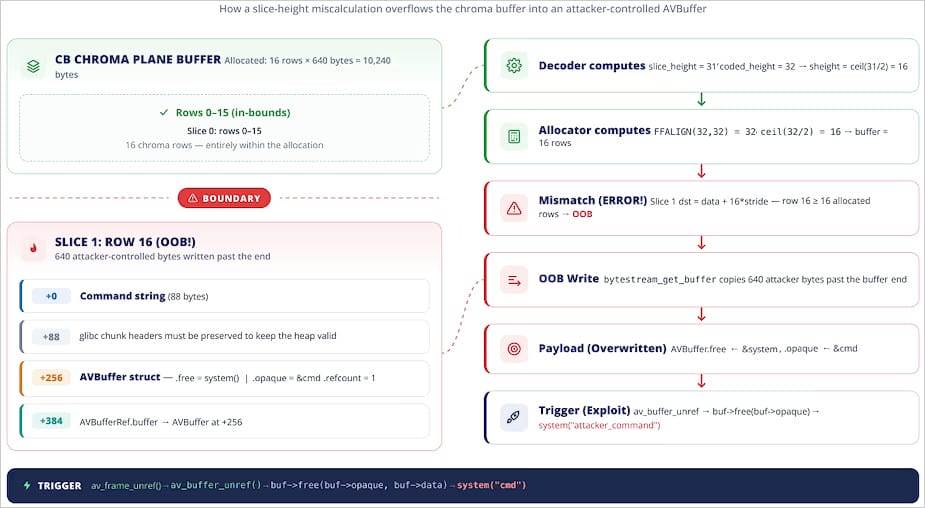 Source: JFrog
PixelSmash can be triggered when the user opens AVI, MKV, or MOV video files, browses a directory containing the file (via thumbnail generation), or runs any automated media ingestion workflow.
JFrog found that multiple popular media applications, such as Kodi, OBS Studio, PhotoPrism, and GNOME/KDE/XFCE’s thumbnail generators, use FFmpeg with the MagicYUV decoder enabled, making them vulnerable to PixelSmash attacks.
Slack, Discord, Telegram, and WhatsApp may also be susceptible to PixelSmash attacks, as they use FFmpeg to generate server-side video previews, but they were not tested.
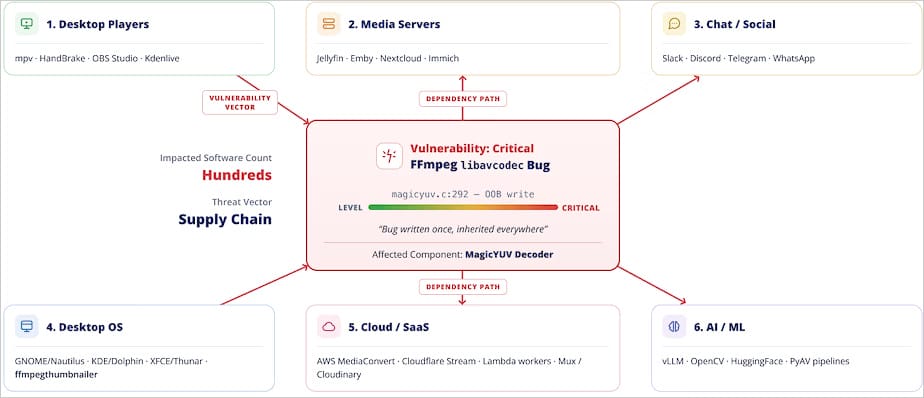 Source: JFrog
JFrog lead researcher Yuval Moravchick demonstrated that PixelSmash can be used for remote code execution on Jellyfin and Nextcloud (with Movie preview enabled) instances.
“To demonstrate the real-world impact, we achieved full remote code execution against a Jellyfin 10.11.9 media server - the second-most popular self-hosted media server (after Plex) - through its normal media library scan pipeline,” JFrog says.
“Attack path: a download of a crafted MagicYUV AVI into the media library -> Jellyfin automatically triggers ffprobe for metadata extraction -> the OOB write fires -> AVBuffer.free is hijacked to system() -> arbitrary command executes as the jellyfin service user.”
However, Moravchick noted that the RCE exploit requires ASLR (Address Space Layout Randomization) to be disabled, and that CVE-2026-8461 alone does not bypass this memory protection.
In theory, a separate information-disclosure bug in FFmpeg's FlashSV decoder could be chained with PixelSmash to bypass ASLR.
Another attack scenario is via torrent downloads and requires no user interaction. The researchers say that an attacker could seed a malicious video that targets Jellyfin users who point the download to the application's media library folder.
"Jellyfin’s real-time file system monitor detects the new file and automatically triggers an ffprobe metadata scan. The exploit fires during the scan - AVBuffer.free is hijacked to system(), and the attacker’s reverse shell command executes as the jellyfin service user"
Even when RCE is prevented or impossible, the CVE-2026-8461 vulnerability should be sufficient to reliably achieve a denial-of-service (DoS) condition on vulnerable targets.
The researchers found that Plex, the massively popular media server, uses a custom FFmpeg build in which decoders are disabled and a minimal allowlist is in effect, effectively mitigating the PixelSmash risk.
Apart from FFmpeg releasing version 8.1.2, which fixes the flaw, Jellyfin also updated its bundled FFmpeg version, and PhotoPrism is working to add a file format blocklist to prevent potential exploitation.
The Nextcloud team received the report via HackerOne, but declined to address the flaw because it exists outside of Nextcloud.
JFrog discovered PixelSmash (CVE-2026-8461) and reported it to the FFmpeg security team on May 13. The developer addressed the issue in version 8.1.2, released on June 17.
The researchers warn that PixelSmash has a huge attack surface because the MagicYUV decoder is present in hundreds of projects that "trust FFmpeg to handle untrusted input safely," turning the vulnerability into a supply-chain problem.

Test every layer before attackers do
Security teams log 54% of successful attacks and alert on just 14%. The rest move through your environment unseen.
The Picus whitepaper shows how breach and attack simulation tests your SIEM and EDR rules so threats stop slipping by detection.





 English (US) ·