


FortiBleed campaign used custom FortiGate sniffer to steal credentials
 1 hour ago
1
1 hour ago
1

Security firm SOCRadar says the large-scale FortiBleed campaign targeting Fortinet FortiGate devices used custom sniffers to harvest authentication secrets from compromised firewalls and steal credentials.
The report, published today, expands on the company's previous research into the large-scale "FortiBleed" campaign, which revealed a collection of Fortinet VPN credentials associated with more than 80,000 firewall URLs worldwide.
According to SOCRadar, the operation targeted more than 430,000 FortiGate firewalls worldwide and has been active since at least February 2026.

The researchers say the threat actor behind this campaign serves as an initial access broker (IAB), using credential stuffing, brute-force attacks, credential harvesting, and offline password cracking to obtain access to corporate networks.
One of the researchers' findings is the alleged use of a Golang-based tool dubbed "FortigateSniffer," which abuses FortiOS's built-in diagnose sniffer packet functionality to capture authentication traffic traversing compromised FortiGate devices.
According to SOCRadar, the attackers abused this legitimate feature on compromised devices to steal credentials from network traffic passing through the firewall.
SOCRadar says the tool was designed to monitor traffic for credentials, password hashes, and authentication secrets from various protocols, including RADIUS, NTLM, Kerberos, and LDAP.
"The tool is designed to monitor traffic across 24 protocols, parse authentication data, and extract credentials from network flows," SOCRadar said in the report.
While Fortinet previously told BleepingComputer last week that this incident is a collection of previously compromised credentials rather than a new vulnerability or incident, SocRadar's report shows an ongoing campaign that is actively compromising FortiGate VPN devices.
Sniffing for credentials
The company says the threat actor deployed a credential-harvesting sniffer framework called "FortigateSniffer" on compromised FortiGate devices after first gaining administrative access via credential stuffing and brute-force attacks.
This tool reportedly connects to FortiGate devices over SSH and launches the FortiOS diagnose sniffer packet command.
The "diagnose sniffer packet" command is a built-in FortiOS diagnostic tool that administrators use to troubleshoot connectivity, authentication, and network performance issues.
The command allows admins to inspect network traffic passing through a FortiGate firewall in real time, making it useful for identifying connection failures, routing problems, and authentication errors.
The command was configured to monitor traffic for authentication protocols and remote access services, including Kerberos, LDAP, SMB, RADIUS, RDP, WinRM, Microsoft SQL Server, MySQL, PostgreSQL, SMTP, IMAP, POP3, FTP, and Telnet.
The report says the packet data collected from FortiGate devices was processed through a component named "SNIFTRAN," which reconstructed the captured traffic into PCAP files.
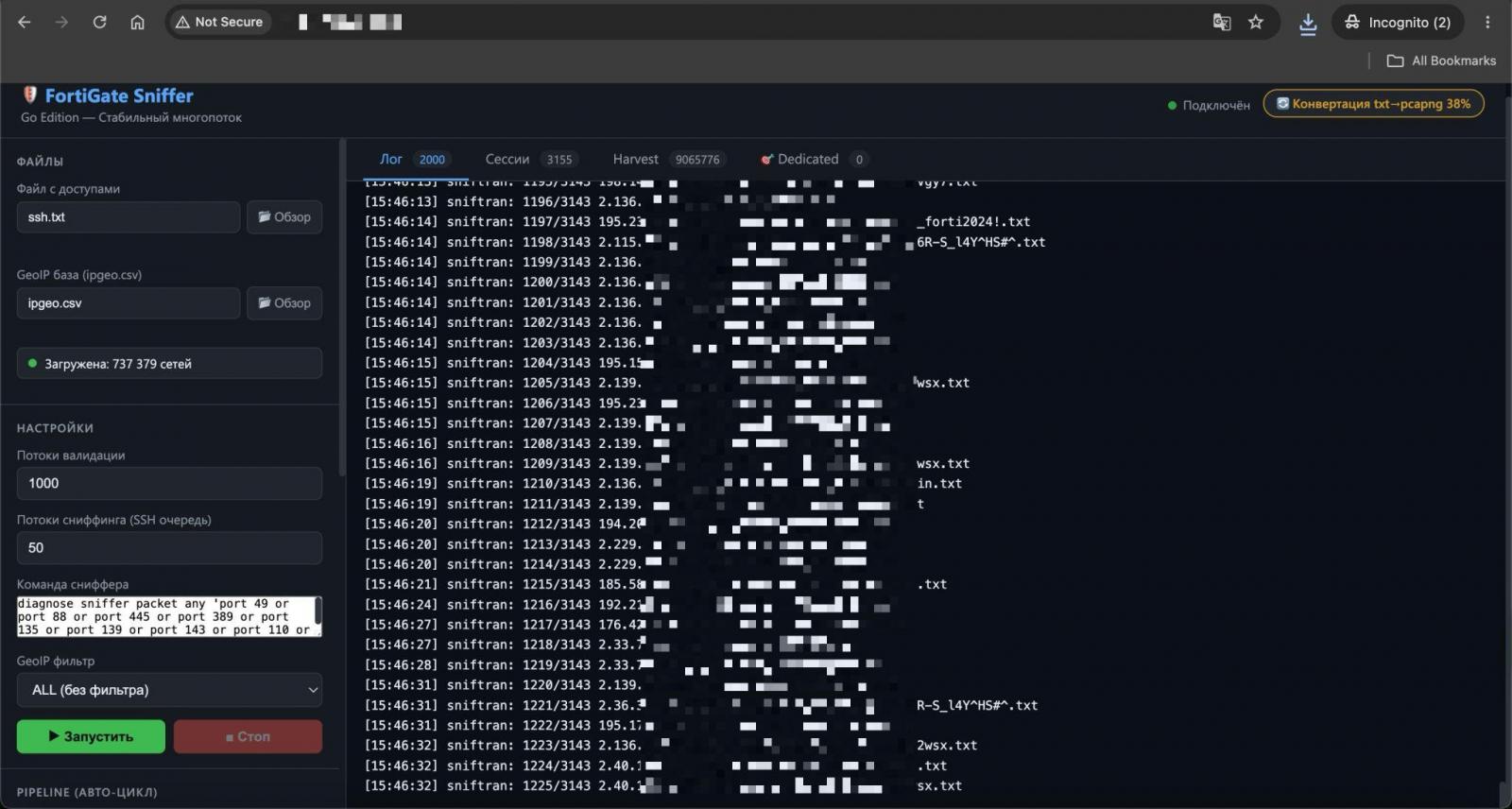 FortiGate Sniffer parsing data through Sniftran
Source: SocRadar
The captured data was then parsed through a Python-based "PCAP Deep Analysis Toolkit" that extracted cleartext credentials, password hashes, Kerberos tickets, NTLM authentication material, email credentials, database credentials, and other authentication artifacts from the network traffic.
Next, the toolkit generated Hashcat-ready files containing NTLM and Kerberos hashes, and extracted cleartext credentials from protocols such as SMTP, IMAP, POP3, MySQL, and RADIUS when available.
The threat actors allegedly used the GPU-based Hashcat password cracking utility running on a distributed GPU cluster to crack the hashed credentials.
In an update published on Friday, cybersecurity expert Kevin Beaumont suggested that the attackers also obtained hashed credentials by downloading FortiGate configuration files from compromised devices.
The threat actors then extracted the hashed credentials and cracked them using Hashcat and 36 enterprise-class GPUs.
"The password cracking was hosted at a GenAI company which rents GPU compute," explains Beaumont.
"The attacker rented 36 enterprise class GPUs — more than most large orgs have for internal AI efforts — and instead of using it for AI tasks, they used them for password cracking. Enterprise GPUs can crack passwords at scale very quickly."
Both explanations could account for the dedicated GPU-based cracking platforms observed on the attacker's servers.
For those managing Fortinet devices, Beaumont has published the list of IP addresses targeted in this campaign.
Organizations utilizing FortiGate devices should review this list and investigate whether any of their systems were targeted or compromised.

Test every layer before attackers do
Security teams log 54% of successful attacks and alert on just 14%. The rest move through your environment unseen.
The Picus whitepaper shows how breach and attack simulation tests your SIEM and EDR rules so threats stop slipping by detection.






 English (US) ·