


India's Telegram ban hit the UAE too. Here's how to get around it
 1 hour ago
1
1 hour ago
1

India has banned Telegram until June 22 after the platform was used to sell access to leaked exam materials.
Telegram CEO Pavel Durov accuses Indian telecom Reliance of using BGP hijacking to enforce the block, disrupting access for users as far away as the UAE.
Digital rights group, the Internet Freedom Foundation (IFF) calls the ban a disproportionate, "constitutionally incompatible" response to exam fraud.

The ban, and the BGP routing fallout
On June 16, India's Ministry of Electronics and Information Technology invoked Section 69A of the IT Act to restrict access to Telegram nationwide until June 22, acting on a recommendation from the National Testing Agency (NTA). A separate order requires Telegram to disable its message-editing feature in India until June 30.
Telegram has since moved the Delhi High Court to challenge the ban, and the court agreed to hear the matter urgently today, but adjourned it for a June 18 hearing:
Delhi High Court issued notice on Telegram’s plea challenging the Centre’s temporary blocking order and granted the respondents time to file their reply along with supporting documents.
The matter will now be heard at 2:30 PM tomorrow.
Telegram sought interim protection against…
— ANI (@ANI) June 17, 2026
The disruption did not stay inside India's borders.
In an X post, Durov alleged that Indian telecom Reliance was "sabotaging" Telegram access for users outside India, including in the UAE, through BGP hijacking.
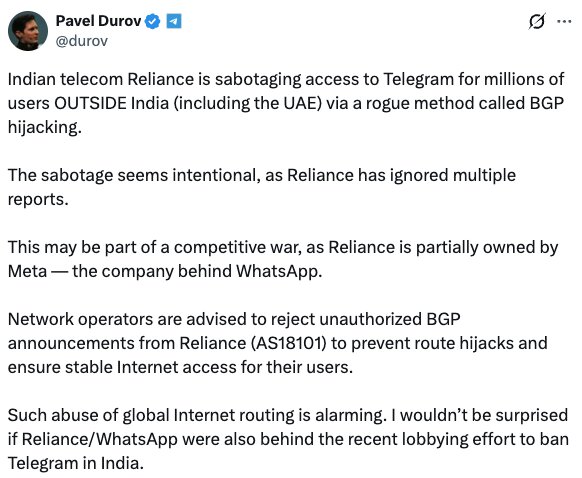 Durov accuses Indian telco of "sabotaging" Telegram via BGP hijacking (X)
He said the disruption looked deliberate because the reports had been ignored, framed it as possible competitive interference given Reliance's ties to Meta, and advised network operators to reject unauthorised BGP announcements from AS18101.
Border Gateway Protocol (BGP) is the routing system that tells networks how to reach each other across the internet.
A BGP hijack happens when a network announces ownership of IP address ranges it does not control, which can redirect, drop or disrupt traffic for the real owner.
Public routing data cited by network observers shows AS18101 began announcing Telegram prefixes around the time the domestic block went live, which would explain why users outside India lost access.
The routing disruption itself is not in question.
Doug Madory, Director of Internet Analysis at Kentik, confirmed AS18101 hijacked Telegram's routes, though he noted RPKI route-origin validation and filtering limited how far the bad route propagated.
Network researcher Anurag Bhatia independently verified it against public routing data.
Technology policy researcher Pranesh Prakash traced the mechanics in a thread: the route leaked to the global internet via FLAG Telecom (AS15412), a former RCom-owned transit provider that failed to drop the RPKI-invalid announcement, which is how users in the UAE and elsewhere lost access.
— Pranesh Prakash (@pranesh) June 16, 2026
What these analysts dispute is Durov's claim that the hijack was deliberate.
Prakash said plainly that he disagreed with Durov, that intentional sabotage was highly unlikely, and that he had seen zero evidence for it, reading the incident instead as a domestic block misconfigured into a global leak.
Madory and Bhatia reached similar conclusions, comparing it to Iraq's 2023 block, where an attempt to cut Telegram domestically leaked the routes outward.
The corporate-rivalry angle is unresolved, contrary to what Durov suggested.
AS18101 is registered to Reliance Communications, the insolvent Anil Ambani-era operator, not Reliance Jio, the Mukesh Ambani carrier in which Meta holds a roughly 10 percent stake. But Prakash noted Jio has absorbed some of RCom's spectrum and fibre assets, and stopped short of identifying who actually originated the hijack, calling it a question reporters would need to dig into.
The routing anomaly is documented. The intent, and the identity of whoever triggered it, are not established.
Why India did it
The trigger is the National Eligibility-cum-Entrance Test (NEET), India's largest medical entrance exam, taken by millions of students.
Question papers were allegedly leaked before the May 3 exam through a paid WhatsApp group and coaching-centre networks in Rajasthan, with reports of a pre-circulated guess paper overlapping heavily with the real test. The exam was cancelled on May 12 and a re-test scheduled for June 21.
India's federal investigating agency, the Central Bureau of Investigation (CBI) took over the probe and has made multiple arrests, including NTA-appointed subject experts and coaching figures.
The NTA says cheating networks used Telegram channels, groups and bots to sell access to exam material and spread misinformation, and that channel administrators abused the edit feature to backdate posts and pass off altered timestamps as proof of a prior leak. That is the stated reason for the editing restriction running to June 30.
The agency described the ban as a "last resort" after channel-by-channel takedowns failed to stop the fraud.
Durov's counterargument is that the ban punishes the wrong people.
He says Telegram removed hundreds of channels sharing leaked material and scams in India in recent weeks, and that banning the app does nothing about the insiders responsible.
The ban also drew sharp political reaction. Karti P. Chidambaram, Congress MP for Sivaganga, asked on X whether blocking Telegram was really the master stroke that would stop exam paper leaks, tagging the NTA.
Telegram replied to him in kind, suggesting the government should also shut every shopping mall in case one had a shoplifter, and close the roads because someone might be speeding.
The problem with blocking platforms
The IFF's objection is procedural as much as practical.
It argues the directions exceed what Section 69A and the blocking rules actually permit, and described the move as a band-aid that fails the proportionality test: a nationwide block on a service used by more than 150 million people to address fraud committed by a handful.
The deeper issue is opacity.
Section 69A blocking orders in India are routinely issued without public reasons, and the list of blocked sites is not disclosed.
The UK's Daily Mail, for example, has been quietly inaccessible across Indian ISPs since 2022, returning DNS resolution errors, with no stated reason and no named ministry behind the decision. It joined thousands of other sites blocked under the same provision with no public explanation.
Telegram is unusual only in its scale and the fact that someone with 150 million users is shouting about it.
The collateral
The people hit hardest are the students the ban was meant to protect.
NEET aspirants built their preparation around Telegram: free study material, paid coaching groups, lecture videos and notes that do not exist anywhere else as conveniently or as cheaply.
my brother’s NEET PG notes, videos and paid study groups were all on telegram
telegram got banned. so now he’s stuck messaging pirated-content scammers just to access what he already paid for
to stop one leaked NEET UG paper, you broke access for thousands of honest aspirants… https://t.co/vfj00h3z81 pic.twitter.com/LkQGPcLRWS
— Apurva Jain (@apurvajain24) June 16, 2026
That captures the asymmetry the IFF is pointing at. The leak source walks free, the platform gets blocked, and the students who paid for legitimate access are the ones locked out.
How to get around the ban
Telegram has built-in support for exactly this scenario.
The app ships with a proxy feature, MTProto (also called MTProxy), designed to route traffic around network-level censorship.
It works by obfuscating Telegram traffic and forwarding it through an intermediary node before it reaches Telegram's servers, so an ISP blocking known Telegram IP ranges no longer sees a direct connection.
The traffic stays end-to-end encrypted throughout, and the proxy operator cannot read messages or identify the account, though they can see the connecting IP address.
Anyone affected by the India or UAE disruption can point their app at a working MTProto proxy and restore access without a full VPN.
There are public proxy lists maintained for this purpose.
StormyCloud runs a free MTProto proxy. There's also the SoliSpirit project on GitHub publishing a list of verified proxies refreshed automatically every 12 hours.
Either gives you working server, port and secret values to plug in.
As always, only use proxies from a source you trust: a malicious operator can log your IP and the times you connect, even if it cannot see your chats. Layering a trusted VPN on top closes that gap.
How to set up a Telegram MTProto proxy (desktop)
1. In the menu, open Settings, and select Advanced.
.png) Select 'Advanced' under Telegram settings (BleepingComputer)
Select 'Advanced' under Telegram settings (BleepingComputer)2. Under Data and storage, click Connection type at the top of the panel.
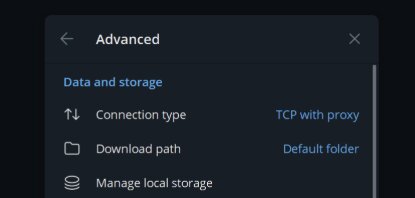
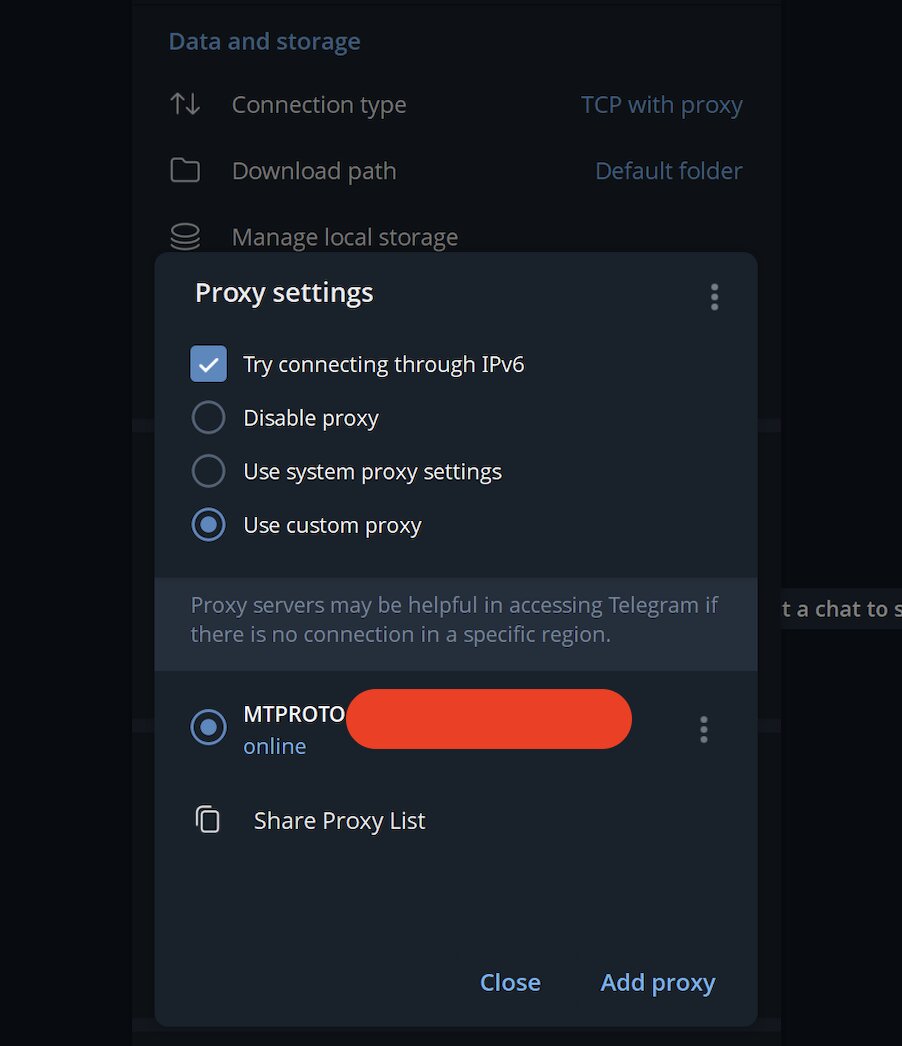
3. In Proxy settings, select Use custom proxy, then click Add proxy.
4. Enter the MTProto server, port and secret from your chosen proxy source. Once saved, the proxy shows as online and Telegram routes through it:
On mobile: the path is Settings > Data and Storage > Proxy (iOS) or Settings > Data and Storage > Proxy Settings (Android), then Add Proxy > MTProto and enter the same server, port and secret.
For now, the restriction is set to lift on June 22, the day after the re-examination, with the editing-feature block running to June 30. Telegram's court challenge could shorten that, and the routing spillover into the UAE may resolve on its own as the India-side block is unwound.
Until then, affected users who rely on the platform have a working route back in through an MTProto proxy. As mentioned, the proxy you choose is only as trustworthy as its operator.
Update, June 17, 11:36 AM ET: Added ANI's X post about court hearing update.

Test every layer before attackers do
Security teams log 54% of successful attacks and alert on just 14%. The rest move through your environment unseen.
The Picus whitepaper shows how breach and attack simulation tests your SIEM and EDR rules so threats stop slipping by detection.






 English (US) ·